
Below you will find two separate projects I worked on within the same Agency and division.
Project One:
Forms and Letters Templating
Forms and Letters Templating
(Due to the proprietary nature of this product, the exact item and client names have been obscured or changed and images are
not enlarged.)
not enlarged.)
Enterprise Correspondence Handling Online (ECHO) System
- Government Agency | Washington, DC + Global Users
- Government Agency | Washington, DC + Global Users
Executive Snapshot:
Modernized a legacy notice-generation workflow into a scalable templating solution for super users and administrators — operating with limited user access, high financial risk constraints, and significant ambiguity.
• Led UX strategy and design as the sole Product Designer
• Built trusted stakeholder relationships in a time-restricted
government environment
government environment
• Embedded cross-functional synthesis into Agile delivery
• Drove adoption interest across departments
• Recognized internally as a strategic HCD partner
The Business Problem
The agency required a modern, scalable templating solution to generate forms and letters within the ECHO system.
Constraints:
• Fee-based agency losing significant revenue during system downtime
• Limited access to end users due to operational risk
• High variability in mailing and correspondence scenarios
• Ambiguous initial requirements with broad design freedom
The challenge was not just usability — it was designing under operational pressure, limited research time, and complex edge cases.
My Role and Responsibilities:
• Content Strategy
• UX Research and Strategy
• Information Architecture
• Product Design and Management
• Service Design
• UX Advocacy and Education
• Content Strategy
• HCD Contract Evangelist
• HCD Contract Evangelist
Solo Product Designer in a Lean Agile team (2-week sprints)Team: 3 Developers, Project Manager / BA, and myself/Product Designer
I partnered closely with the PM / BA and Lead Developer from discovery through delivery — aligning user insight, roadmap priorities, and technical feasibility in real time.
Strategic Leadership Response:
Limited User Access in a High-Risk Environment to HCD
Constraint
User interviews and usability testing were sensitive due to potential financial loss from downtime.
Approach
• Designed a focused, high-efficiency interview strategy
• Secured access to two key SMEs
• Built trust through structured, respectful engagement
• Established an ongoing consultative feedback loop
Leadership Move
Included PM/BA and Lead Developer in all interviews to create shared understanding and eliminate downstream misalignment.
Impact
• Faster synthesis
• Reduced handoff friction
• Business and technical constraints considered at the moment of insight
• Elevated UX influence across the team
Complex Mailer and Envelope Configuration Logic
Constraint
Designing a flexible interface to accommodate numerous envelope mailing address scenarios and print constraints.
Approach
• Facilitated iterative scenario mapping sessions
• Collaboratively surfaced all possible address variations
• Structured UI logic to scale across edge cases
• Balanced flexibility with cognitive simplicity
Outcome
Delivered a configurable interface that reduced ambiguity while supporting operational realities.
Proceeding in Ambiguity
• Translated loosely defined requirements into structured product direction
• Balanced system constraints, policy requirements, and usability
• Used “what if” collaborative sessions with stakeholders to test
assumptions early
assumptions early
• Integrated service design thinking across system touchpoints
• Partnered tightly with front-end engineering to co-create feasible,
performant solutions
performant solutions
This was not a linear process — it required constant negotiation between user value, business risk, and system capability.
Cross-Functional Model That Drove Efficiency
This project became an example of high-functioning Agile collaboration:
• PM/BA contributed roadmap and requirement framing during synthesis
• Developer contributed technical foresight during ideation
• I ensured user-centered integrity across decisions
Result:
• Reduced rework
• Faster prioritization
• Informed trade-offs in real time
• Strong mutual respect across disciplines
Business Impact
Although the initiative was deprioritized due to shifting agency priorities, measurable impact included:
• High stakeholder satisfaction and visible excitement for roadmap features
• Recognition from another department requesting similar
HCD-led engagement
HCD-led engagement
• Elevated credibility of UX within the agency
Internal Feedback:
“Everybody wants more of your great work!”
This project increased internal demand for user-centered design and positioned UX as a strategic enabler — not just a design function.
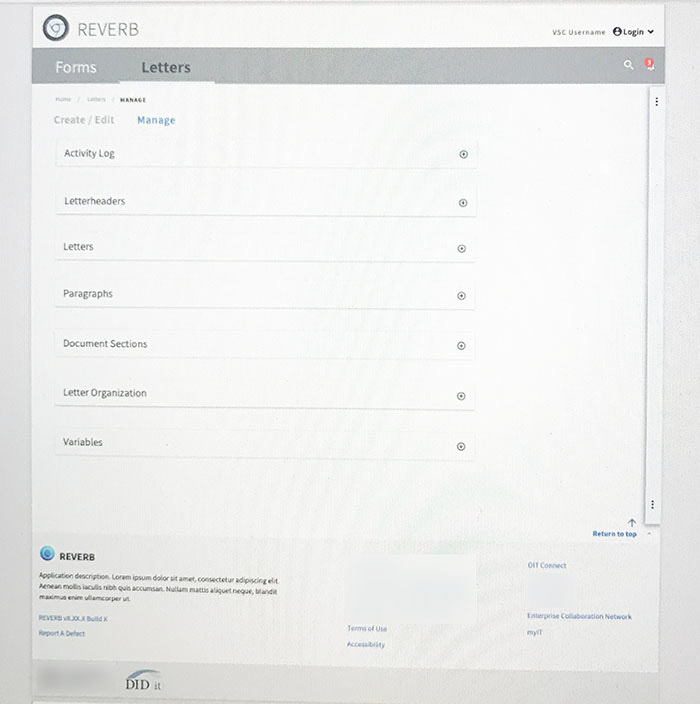
REVERB - View 1
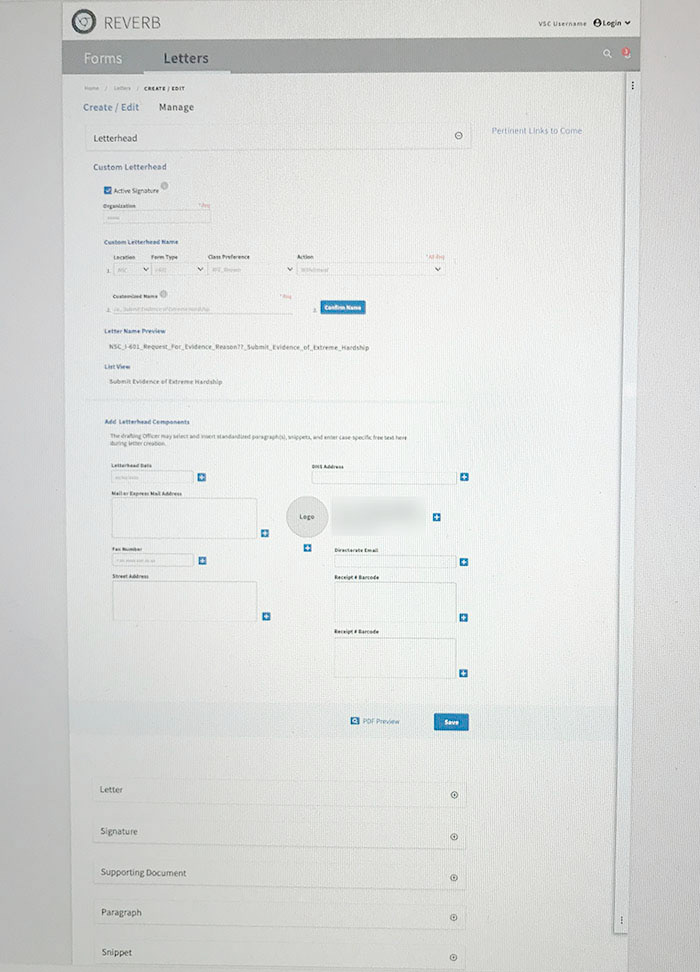
REVERB - Mailer Setup
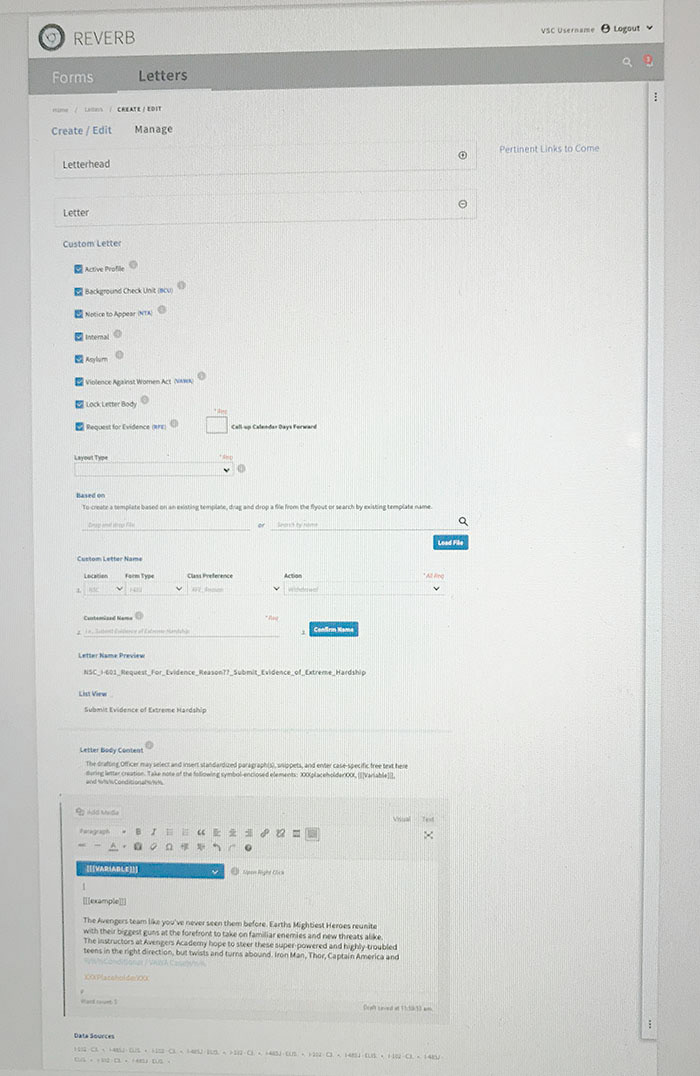
REVERB - Letter Setup
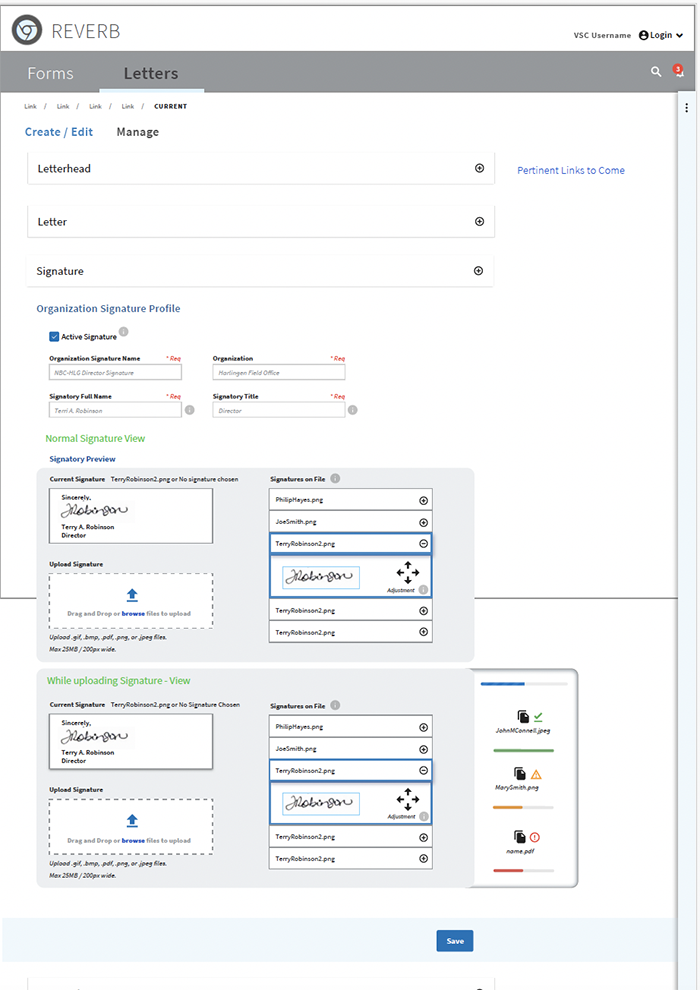
REVERB - Signature Management
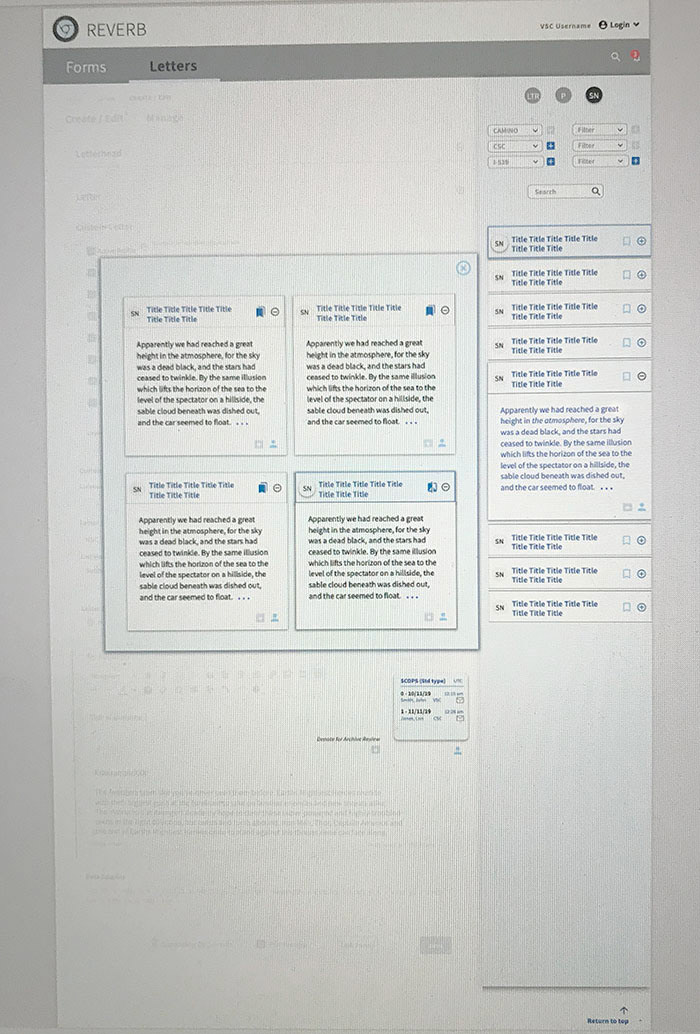
REVERB - Templated Letter Sections
Views of REVERB prototypes.
What This Case Demonstrates
• Senior-level ownership in constrained enterprise environments
• Strategic UX leadership without a large research budget
• Ability to influence cross-functional teams
• Comfort operating under ambiguity
• Design systems thinking within complex government infrastructure
• Executive-level communication and stakeholder trust-building
___________________________________________________________________
Project Two:
Country of Origin (COI) Application Redesign
Country of Origin (COI) Application Redesign
Modernizing a mission-critical adjudication tool under tight constraints
Executive Outcome:
• Transformed a developer-built legacy system into a modernized,
human-centered application used to safeguard refugee and
asylum decisions.
human-centered application used to safeguard refugee and
asylum decisions.
• Introduced UX discipline into a previously design-less product,
establishing research, Info Architecture, and iterative validation practices.
establishing research, Info Architecture, and iterative validation practices.
• Improved information architecture clarity, reducing duplication and
exposing broken content relationships across complex geopolitical data.
exposing broken content relationships across complex geopolitical data.
• Accelerated deployment cadence within a Lean Agile model—releasing
more frequently than other parallel programs.
more frequently than other parallel programs.
• Elevated UX maturity across the broader contract, influencing adjacent
teams to adopt structured IA documentation and HCD practices.
teams to adopt structured IA documentation and HCD practices.
• Delivered a comprehensive handoff-ready site architecture artifact,
adopted as a model across teams at contract end.
adopted as a model across teams at contract end.
Context:
The Country of Origin (COI) application supported Adjudications Officers before, during, and after applicant interviews.
It worked in tandem with the Global Interview (GI) application and contained highly detailed geopolitical intelligence — including:
• International regions and subregions
• Militant group activity
• Historical events tied to time and location
• Reference material used to validate asylum claims
Constraint:
The system had been designed entirely by developers with no UX research or HCD lens. It served a very small but highly specialized user group (Approximately 3 super users/admin stakeholders), which historically limited investment in design and research.
The system had been designed entirely by developers with no UX research or HCD lens. It served a very small but highly specialized user group (Approximately 3 super users/admin stakeholders), which historically limited investment in design and research.
My Role:
• Content Strategy
• UX Research and Strategy
• Information Architecture
• Product Design and Management
• Service Design
• UX Advocacy and Education
Solo Product Designer in a Lean Agile team (2-week sprints)
Team: 3 Developers, Project Manager / BA, and myself/Product Designer
Team: 3 Developers, Project Manager / BA, and myself/Product Designer
I partnered closely with the PM / BA and Lead Developer from discovery through delivery — aligning user insight, roadmap priorities, and technical feasibility in real time.
Strategic Challenges:
• Highly complex content ecosystem with weak relational structure
• Minimal freedom in feature direction (stakeholder-driven roadmap)
• Extremely small user base limiting formal research breadth
• Tight coupling with external system (GI) requiring architectural alignment
• Security-sensitive, mission-critical context
Strategic Interventions:
Embedded Human-Centered Design
Into a Controlled Environment
Into a Controlled Environment
• Conducted foundational stakeholder interviews at project initiation
• Established weekly prototype demos with real-time validation
• Leveraged direct access to primary user for rapid iteration cycles
• Introduced modern interaction patterns incrementally to build trust
Despite roadmap constraints, I reframed conversations around:
• Workflow efficiency
• Cognitive load reduction
• Information discoverability
• Decision-support clarity
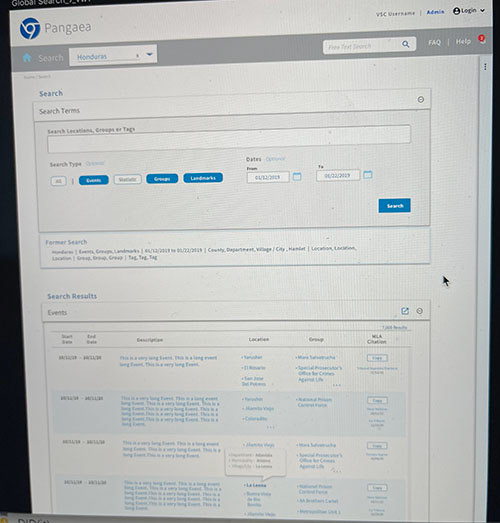
Pangea View 1
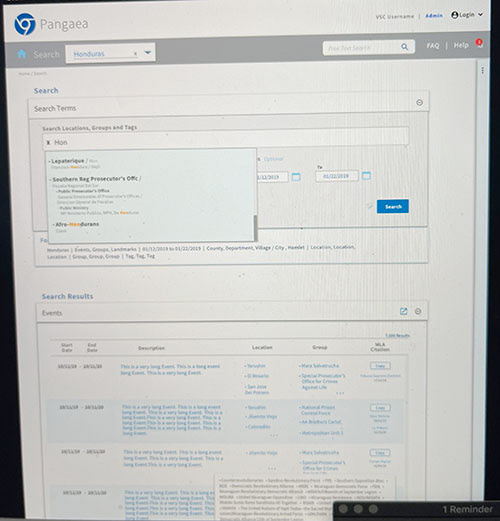
Pangea View 2
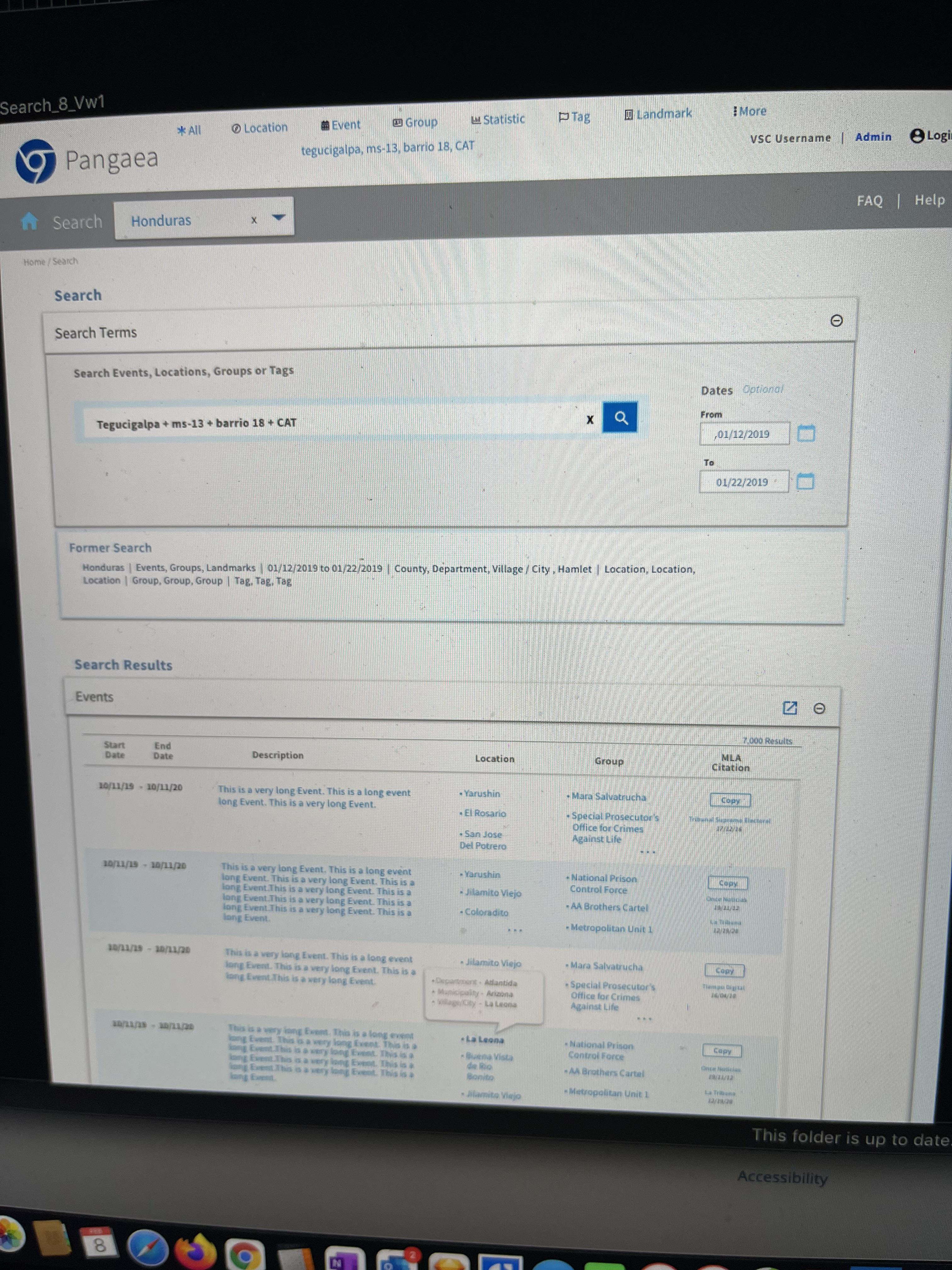
Pangea View 3
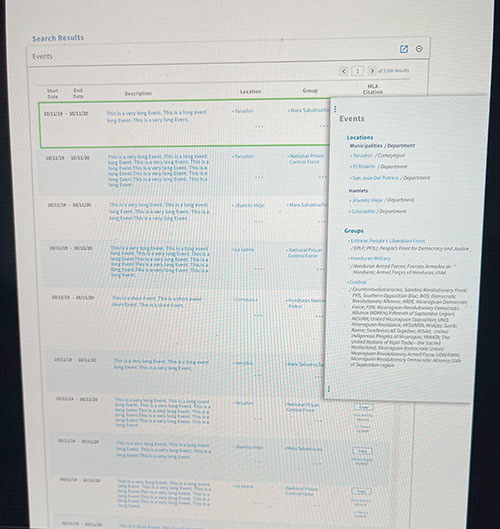
Pangea View 4
Views of proposed layouts.
Re-Architected the Information Structure
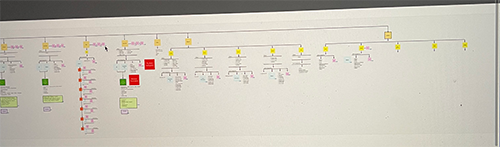
To address systemic complexity, I created a full Current-State Site Architecture artifact.
Impact of this deliverable:
• Exposed redundant content and broken relational models
• Identified gaps between COI and GI pairing logic
• Clarified data dependencies across geopolitical entities
• Became the primary team knowledge-transfer usher at contract close
Program leadership later required similar IA artifacts across other teams — expanding the influence of this work beyond a single product.
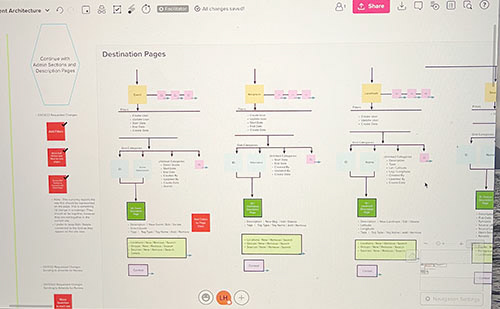
Site Architecture 1
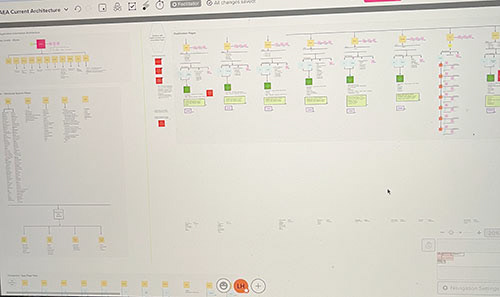
Site Architecture 2
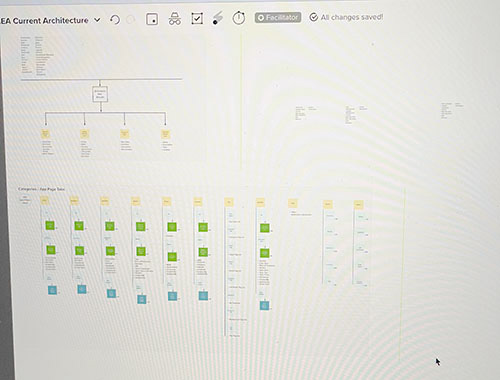
Site Architecture 3
Site Architecture 4
Site Architecture Artifact Views
Elevated Agile plus HCD Integration
This contract uniquely allowed the UX function to:
• Define realistic timelines (rather than inherit externally imposed ones)
• Plan work based on research-informed scope
• Deploy continuously without deadline compression
Result:
• Increased deployment frequency
• Reduced rework cycles
• Higher stakeholder satisfaction
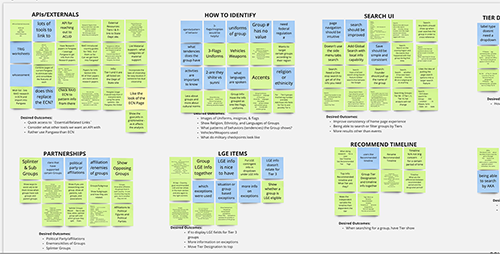
Synthesis of Client Data after Interviews
Leadership and Influence:
Beyond direct product work, I:
• Championed UX best practices across teams lacking design experience
• Facilitated knowledge sharing across portfolios
• Organized a cross-team Designer Retreat featuring respected
external speakers
external speakers
• Helped build a collaborative, learning-driven culture within a
remote program
remote program
• Served as a connector across silos to drive continuous improvement
I functioned not just as a designer, but as a strategic UX advocate embedded within a government program environment.
What Made This Engagement Exceptional:
• Leadership protected HCD practices within Agile delivery
• User research and needs dictated the roadmap and timelines
• Cross-team demos fostered transparency and shared learning
• Strong PM/BA partnership aligned research insights with
roadmap execution
roadmap execution
• Developer collaboration was continuous, shaping technically informed
design decisions
design decisions
• Culture emphasized high performance and human connection
• This environment enabled rapid delivery without sacrificing quality or
research integrity.
research integrity.
Project Impact:
• Stakeholder enthusiasm and approval for modernized functionality
• Increased clarity in adjudication workflows
• Stronger system alignment between COI and GI
• Formalized IA documentation adopted program-wide
• Established UX credibility in a historically developer-led space
Although the contract concluded before full system maturation, the foundation positioned the incoming vendor for success.
Recognition:
During this assignment, I received three formal program awards:
___________________________________________________________________
The Steven Cheever award - For Taking on Challenges and Showing Courage in the Workplace (Nomination One)
Lynn has been a champion for Human-Centered Design and Usability Excellence in every initiative she has supported. In several cases, Lynn has found herself on a team with limited experience working with a designer.
She is an advocate for end users and is passionate about spending appropriate time researching and gathering requirements from them.
In December, Lynn organized a "Designer Retreat" and worked hard to schedule very well-known and talented speakers throughout the day. It was a great way for us to get together and learn from others in our design community. Thanks for all you do Lynn, congratulations on taking on challenges and being courageous in the work place.
___________________________________________________________________
The Steven Cheever award - For Taking on Challenges and Showing Courage in the Workplace (Nomination Two)
Lynn Hamberger leads her team(s) in guiding them towards the best practices of User Centered Design and continuous delivery.
She is always willing to volunteer to support other aspects of the program, whether it be training, knowledge sharing, or welcoming a new teammate, Lynn is a fountain of positive culture and innovation. Perhaps this is because she is never Siloed, but always aware of, and in sync with what's happening on other teams & portfolios within the DID(it) program. This is part of how she drives continuous improvement and helps all of the teams advance together!
Let’s hear it for Lynn Hamberger, she is 1 in a million!
___________________________________________________________________
Team Gem Award - Excellence In Teamwork
Lynn Hamberger is special, not just because she has amazing artistic talent, but because she greets every task with passion and inspiration.
Lynn always jumps up to volunteer and take on more work, not just for her team, but for the entire program. Thanks to Lynn for being a great role model and all around team player!
Lynn has a CAN DO ATTITUDE, always going above and beyond what is asked of her to make the project better and does whatever it takes to represent DID(it) in the best way!
Senior Level Positioning:
This project demonstrates:
• Operating effectively under constrained autonomy
• Influencing systems beyond direct design control
• Structuring complex information ecosystems
• Embedding HCD within government Agile delivery
• Leading without authority
• Scaling UX maturity across programs
And, it reflects my ability to function as a strategic UX partner, not just a feature-level designer — particularly in high-ambiguity, high-stakes environments.